Welcome to our August 2026 platform update.
The latest updates to the fulfilmentcrowd platform are focused around a common goal: giving brands more control while removing friction from day-to-day fulfilment.
Recently released features include regional pre-release dates, greater control over warehouse selection, improved packing information and a better support ticket experience.
But some of the most significant work is happening behind the scenes.
We’re currently testing a new approach to carrier consignment that will allow us to identify potential delivery problems before warehouse teams begin picking an order. Alongside this, we’re continuing to develop Fai to help customers resolve more questions themselves, faster.
Manage product launches with regional pre-release dates
Brands launching products across multiple markets don’t always want every order to enter fulfilment at the same time.
A product might launch in the UK on one date, for example, before becoming available to customers in the EU or elsewhere in the world at a later stage.
Our new Pre-Release Dates functionality gives brands greater control over this process.
Pre-release dates can now be configured against individual products for three destination regions:
- UK
- EU
- Rest of World (ROW)
When an order is placed for a product with a pre-release date, we check the destination against the relevant regional release date.
If that date hasn’t arrived yet, the order is automatically placed on hold and won’t be released for processing until the specified date is reached.
If there’s no pre-release date configured for the destination region, the order continues through fulfilment as normal.
Taking manual intervention out of product launches
The real benefit is control without additional administration.
Brands can load products and orders into the platform ahead of a launch without relying on teams to manually release orders at the right moment.
That makes the functionality particularly useful for businesses managing pre-orders, coordinated product launches, limited releases or products with different launch schedules across international markets.
Instead of managing those rules outside the fulfilment process, release timing can now be built directly into the product configuration.
Greater control over which warehouse fulfils an order
We’ve also added more flexibility for brands using order uploads.
Retailers can now override the dispatch warehouse when uploading orders, allowing orders to be directed towards a chosen fulfilment location.
There’s also an option to force fulfilment from the selected warehouse only.
For brands operating inventory across multiple fulfilment centres, there are situations where an order needs to leave from a particular location rather than following the standard warehouse selection process.
The new functionality provides greater control in those scenarios, allowing warehouse requirements to be specified as part of the order upload process.
This is particularly useful where stock positioning, operational requirements or specific fulfilment arrangements mean orders need to be handled by a particular site.
More shipment visibility with packing notes
Packing information is now available against Dispatched Orders and Custom Orders, providing additional visibility into how shipments were physically prepared.
Packing notes include information such as carton contents and pallet breakdowns.
That means customers reviewing a completed order can see more than simply whether it was dispatched. They can better understand how the goods were divided across the shipment.
This becomes particularly useful for larger or more complex consignments involving multiple cartons or pallets, where knowing the structure of the shipment can help with verification, onward logistics and investigating queries after dispatch.
By keeping this information against the order itself, teams have a clearer record of what left the warehouse and how it was packed.
Easier-to-identify inventory transfers
We’ve also improved the customer-facing references associated with inventory transfers.
The change makes individual transfers easier to identify within the platform, helping customers distinguish between stock movements and locate the transfer they’re looking for more quickly.
For businesses regularly moving inventory between locations, clearer references reduce ambiguity and make it easier to follow individual stock movements through the operation.
A better experience when raising support tickets
Several improvements have also been introduced to ticketing functionality.
Customers can now attach larger files to tickets following an increase to the upload size limit.
The message entry box has also been updated so that it automatically expands as you type. Longer messages are therefore easier to write and review without having to navigate within a small fixed text field.
Files can now be added using drag and drop, while attached images appear as thumbnails that can be opened and previewed before the ticket is submitted.
Individually, these are relatively small changes. Together, they make it easier to provide our support teams with the information and context needed to investigate a query.
What's coming next?
Alongside recent releases, we're currently testing an exciting adjustment to when we consign orders in the fulfilment workflow.
Moving carrier consignment earlier
One of the most significant developments currently being tested across fulfilmentcrowd is pre-consignment, a change in one of the most important stages of the fulfilment sequence.
Carrier consignment has traditionally happened relatively late in the physical fulfilment process. An order progresses through the warehouse and, when it reaches packing, the information needed to create the carrier consignment is submitted.
Most of the time, that works exactly as intended. But problems happen when it doesn't.
An order can encounter an issue when the carrier attempts to create the consignment – perhaps because of an address problem, missing product information or another piece of data required for the selected delivery service.
By that stage, warehouse labour may already have been committed to the order.
The products have been picked. The order has reached the packing bench. And only then does the operation discover something is preventing it from progressing towards dispatch.
We want to identify those problems much earlier.
What we're testing
Pre-consignment moves the carrier interaction further upstream.
Instead of waiting until the order reaches packing, we'll attempt to create the carrier consignment before warehouse picking begins.
This effectively gives the system an opportunity to prove that an order can progress through the delivery process before physical warehouse work is committed to it.
If everything is correct, the order can proceed. If there’s a problem, we know about it earlier.
Potential issues could include incomplete or invalid delivery information, missing dimensions, weight information or commodity data required to process the shipment.
Finding these issues before picking creates a much larger window in which they can be investigated and resolved.
That can mean fewer orders becoming stuck at packing, less wasted warehouse effort and a better opportunity to protect the order’s intended dispatch SLA.
It should also provide better visibility to customers when something requires attention. As testing continues, we'll keep you updated on these enhancements to our warehouse workflow.
Why Product Data Health is becoming even more important
There’s an important dependency behind all of this: the platform can only make intelligent decisions using the information available to it.
As fulfilment becomes more automated, complete and accurate product data becomes increasingly important.
For example, if the system needs to calculate an expected package configuration for an order without relying on previous packing history, it needs accurate information about the products involved.
That includes data such as:
- Product dimensions
- Product weights
- Commodity information
Missing or inaccurate information limits what the system can determine automatically.
That’s why Product Data Health is becoming more than simply a way to keep product records tidy.
The feature gives customers a clear indication of whether essential information has been completed against products and highlights fields that require attention.
As more intelligent functionality is introduced, maintaining good data health will increasingly help unlock those capabilities.
The relationship is straightforward: better data gives the platform more information to work with, which creates more opportunities to automate decisions and identify problems earlier.
For customers, keeping product information complete now will help ensure they’re better prepared for functionality such as pre-consignment as it becomes available.
Fai check-in: continuously improving our AI support agent
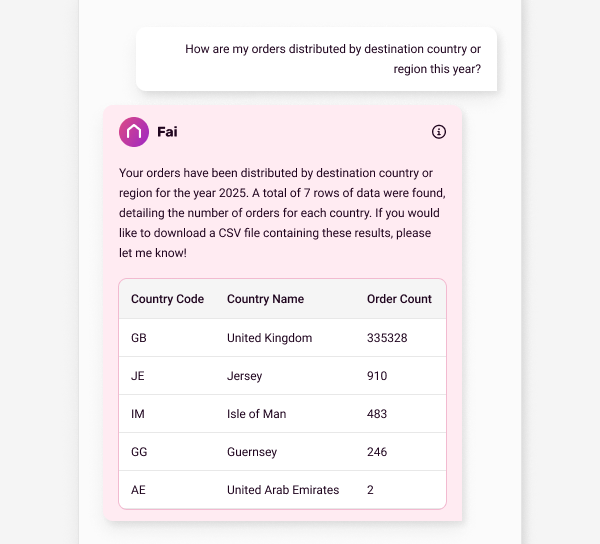
Alongside fulfilment automation, we’re continuing to expand the capabilities of Fai, our AI support assistant.
The current focus is on helping customers resolve common operational questions before they need to raise a support ticket.
It could explain whether an order can still be edited, outline the actions currently available and direct the customer towards the appropriate self-service functionality where possible.
There’s an important time element here, too. If a customer can get the right answer immediately, there may still be an opportunity to make the required change before fulfilment progresses.
Waiting for a support interaction could mean that window has closed by the time the query is resolved.
The objective is therefore not simply to reduce support tickets, but to help customers get useful answers quickly enough to act on them.
Help shape the future of fulfilmentcrowd
We're also looking beyond today's updates.
As we continue exploring new opportunities around automation, AI and operational intelligence, we're keen to understand how customers work today and where fulfilmentcrowd can add the most value in the future.
We're particularly interested in learning:
- Which applications you spend most of your day using
- How fulfilmentcrowd fits into your workflow
- What fulfilment questions you regularly need answering
- Where better automation or AI could save you time
Your feedback will help shape future development priorities and influence how fulfilmentcrowd evolves over the coming months and years.
If you'd like to contribute, we'd love to hear from you.
Want to discuss anything with the team?
Reach out to your account manager or raise a support ticket. We're always open to hearing your feedback – it's your daily experiences that help us create a better platform.
We'll continue sharing detailed updates as new features move from roadmap to release.





.webp?width=300&name=Drone%20Magna%20Park%20(2).webp)





 By Austin Waddecar


.png?width=900&name=jan-26-platform-update3%20(5).png)
.png?width=900&name=jan-26-platform-update3%20(3).png)