
As eCommerce businesses grow, so does the technology stack behind them.
What starts as a relatively straightforward setup – perhaps a Shopify store, a courier account and a spreadsheet or two – can quickly evolve into a web of platforms, marketplaces, fulfilment systems, carriers, ERPs and customer service tools. It’s a whole lotta management, but someone’s got to do it.
Before long, you've got stock data in one system, order information in another, shipping updates somewhere else entirely and at least one team member who seems to spend half their day moving information from one screen to another (we see you and we feel your pain).
This is where eCommerce integration becomes essential.
A good integration not only connects systems, but removes friction from your operation, improves visibility and helps your business scale without adding unnecessary complexity.
In this guide, we'll explore what eCommerce integration means, what a good integration looks like, the different types of integrations available and how businesses can use them to create a more connected, efficient operation.
What is an eCommerce integration?
At its simplest, an eCommerce integration is the process of connecting different business systems so they can automatically share data and work together.
Rather than manually transferring information between platforms, integrations allow systems to communicate in real time.
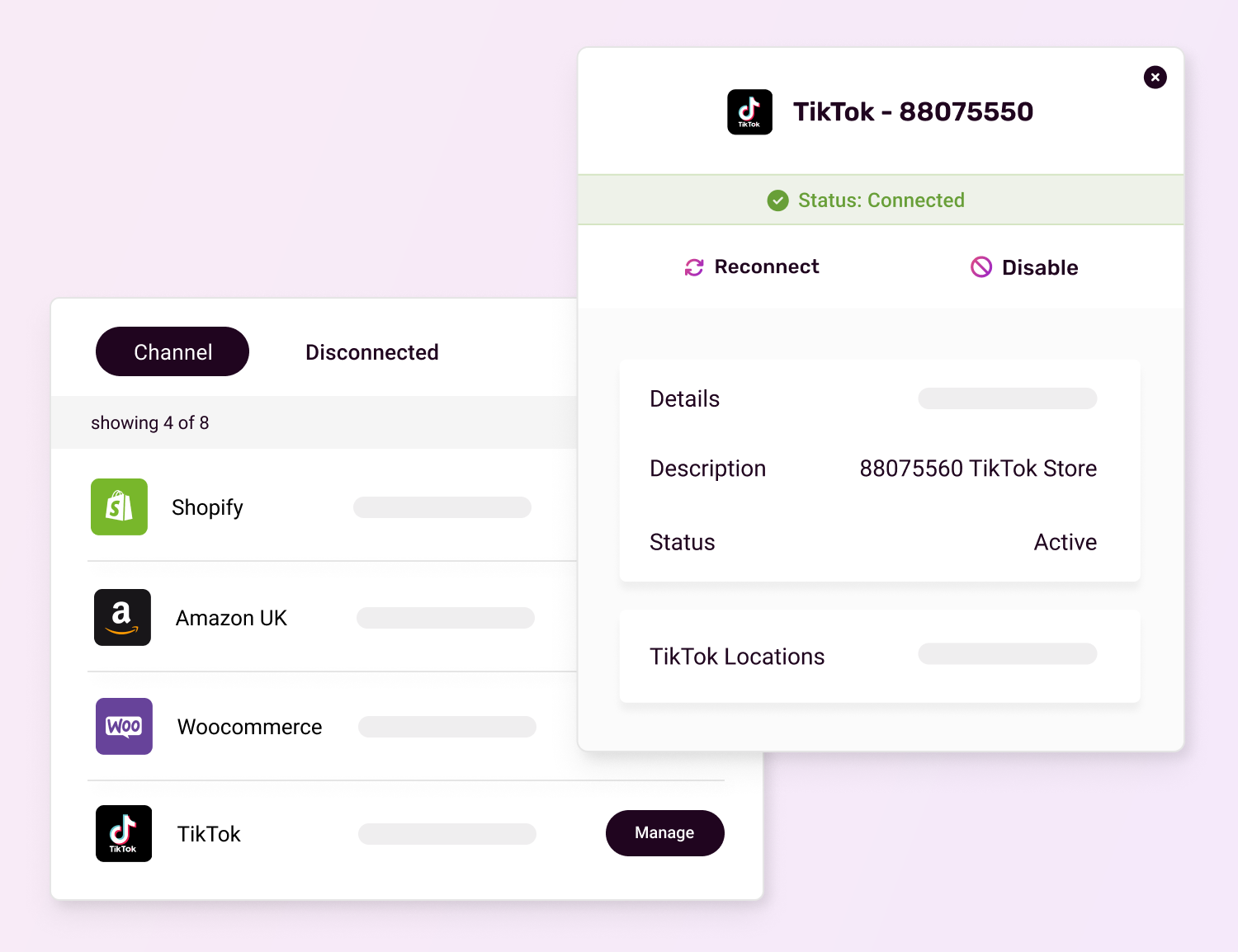
For example, when a customer places an order on Shopify, an integration can automatically:
- Send the order to your fulfilment provider
- Update stock levels
- Generate shipping information
- Share tracking details with the customer
- Update reporting systems
All without anybody needing to export a spreadsheet before their first coffee.
A strong eCommerce integration strategy helps ensure data flows smoothly between the various platforms that power your business.
Why integrations matter more than ever
Modern eCommerce businesses rarely operate from a single platform, putting even more value on a good eCommerce marketplace integration.
Many brands now sell through:
- Their own website
- Amazon
- eBay
- TikTok Shop
- Zalando
- Bol
- Wholesale portals
- Physical retail locations
At the same time, they may also be using:
- ERP systems
- Warehouse management systems
- Customer service platforms
- Marketing automation tools
- Accounting software
- Shipping carriers
The more systems involved, the greater the potential for disconnected data and manual work.
Without effective integrations, businesses often experience:
- Stock discrepancies
- Delayed order processing
- Increased manual administration
- Poor inventory visibility
- Customer service issues
- Reporting inaccuracies
Most businesses don't notice a poor integration until something goes wrong.
Usually during peak trading.
Usually on a Friday afternoon.
Usually when your product has gone viral on TikTok because Kylie Jenner was seen brushing her fingers over it in the supermarket.
What does a good eCommerce integration look like?
Not all integrations are created equal.
A good B2B or eCommerce integration should do more than simply move data between systems. It should improve operational efficiency while providing confidence that information is accurate and up to date.
Here are some of the key characteristics of a strong eCommerce integration.
Real-time data synchronisation
Customers expect accurate stock availability and fast order processing.
A good integration updates information in real time, ensuring inventory levels, order statuses and shipping information remain accurate across all platforms.
If your website says you have 50 products in stock, but your warehouse says otherwise, problems tend to follow fairly quickly. Usually in the form of angry and disappointed customers who take their business elsewhere.
Reliability
Integrations should work consistently and accurately.
The best integrations operate quietly in the background without requiring constant monitoring or intervention.
Because if someone has to manually check every order to make sure the integration has worked properly, it rather defeats the purpose.
Scalability
What works for 100 orders per month likely won’t work for 10,000.
A good integration should support future growth without requiring major redevelopment every time the business expands into a new channel or market.
Visibility
Integrations should improve visibility across your operation.
Teams should be able to access accurate information on:
- Inventory
- Orders
- Deliveries
- Returns
- Customer activity
…without needing to jump between six different systems to find it.
Flexibility
eCommerce changes pretty fast (we know, stating the obvious).
New marketplaces emerge, customer expectations evolve and businesses adopt new technologies.
Good integrations should be flexible enough to accommodate future growth and new opportunities.
Common eCommerce integrations
Different businesses require different integration strategies depending on their sales channels, fulfilment model and operational complexity.
Let's look at some of the most common types of eCommerce integration.
Shopify integrations
Shopify remains one of the most popular eCommerce platforms for growing brands.
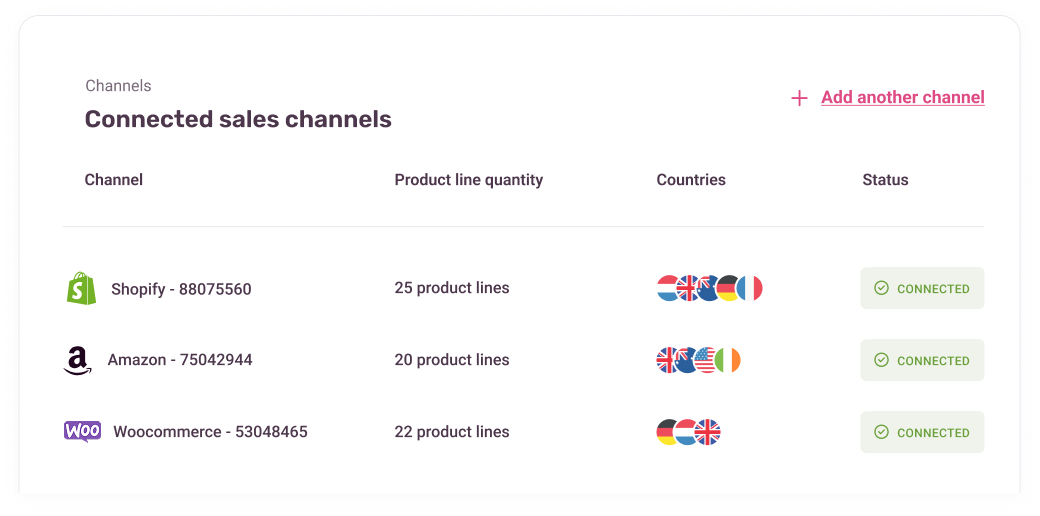
A Shopify eCommerce marketplace integration typically connects the platform with:
- Fulfilment providers
- Warehouse management systems
- Carrier networks
- Customer service tools
- Accounting software
This allows orders, inventory updates and tracking information to flow automatically between systems.
For fast-growing brands, these integrations can significantly reduce manual administration while improving customer experience.
eCommerce marketplace integration
Many brands now sell across multiple marketplaces in addition to their own website. This makes eCommerce marketplace integration increasingly important.
Common marketplace integrations include:
- Amazon
- eBay
- TikTok Shop
- Zalando
- Etsy
- Bol
- ManoMano
Marketplace integrations help businesses centralise order management and inventory control across multiple channels.
Without them, teams often find themselves manually updating stock levels and processing orders across several platforms, which can become challenging (to put it nicely) once order volumes start increasing.
ERP integrations
As businesses become more complex, many adopt Enterprise Resource Planning (ERP) systems to manage operations.
Popular ERP platforms include:
- NetSuite
- SAP
- Microsoft Dynamics
- Brightpearl
ERP integrations help connect commercial operations with fulfilment, inventory, finance and reporting systems.
This creates a more complete view of business performance while reducing duplication of effort.
For larger businesses, ERP integration often becomes a critical part of operational efficiency.
B2B eCommerce integration
While much of the conversation focuses on direct-to-consumer sales, B2B eCommerce integration is equally important.
B2B businesses often require integration between:
- Wholesale portals
- ERP systems
- Inventory management tools
- Pricing systems
- Customer account platforms
These integrations help automate ordering processes, improve inventory visibility and support customer-specific pricing structures.
The result is a smoother experience for both businesses and their customers.
Integration platforms and middleware solutions
One challenge many growing brands face is the sheer number of systems involved in their operation.
Connecting every platform individually can become difficult to manage as the business scales.
This is where integration platforms and middleware (not to be confused with Middle Earth) solutions come in.
Rather than creating dozens of individual connections, these platforms act as a central hub that connects multiple systems through a single interface.
Benefits include:
- Centralised visibility
- Reduced complexity
- Faster onboarding
- Easier maintenance
- Greater scalability
Examples include integration platforms that connect eCommerce stores, marketplaces, ERPs, fulfilment providers and carrier networks into one ecosystem.
For growing brands, this can provide a far more manageable approach to integration than maintaining multiple point-to-point connections.
How integrations improve fulfilment operations
One of the biggest benefits of eCommerce integration is its impact on fulfilment.
Strong integrations help create a more connected fulfilment operation by improving:
- Inventory accuracy: Stock levels are updated automatically across channels, reducing the risk of overselling.
- Order processing speed: Orders flow directly into fulfilment systems without manual intervention.
- Customer communication: Tracking information can be shared automatically, improving transparency and reducing support queries.
- Reporting and visibility: Businesses gain a clearer view of inventory, order volumes and operational performance.
- Scalability: Integrated systems support growth without requiring significant increases in manual administration.
Ultimately, good integrations allow fulfilment operations to run more efficiently and consistently.
Which is exactly what growing brands need when customer expectations continue to rise.
Choosing the right integration strategy
There is no one-size-fits-all approach to integration.
The right strategy depends on:
- Sales channels
- Business size
- Operational complexity
- Existing technology stack
- Future growth plans
The important thing is to think beyond today's requirements.
The best integrations don't just solve current challenges. They create a foundation that supports future growth (corny, but true).
Because replacing technology is one thing. Replacing technology while simultaneously managing rapid growth is considerably less fun. Trust us, we’ve seen it happen.
Final thoughts
As eCommerce businesses grow, integration becomes less of a nice-to-have and more of a necessity.
A strong eCommerce integration strategy helps businesses reduce manual processes, improve visibility, enhance customer experience and create a more scalable operation.
Whether you're connecting Shopify to your fulfilment provider, implementing an ERP integration or managing multiple marketplace channels, the goal remains the same:
To create a connected ecosystem where data flows seamlessly between systems.
The best integrations aren't usually the ones people wax lyrical about on LinkedIn. They're the ones quietly doing their job in the background while your team focuses on growing the business. And in the end, isn’t that what it’s all about?


/2026-09-01/Tech.png?width=640&name=Tech.png)